Measure a ring that already fits
If you already own a ring that fits the finger you have in mind, it is the best reference you have. Measuring a ring removes the guesswork of wrapping something around skin, which can compress or stretch as you pull it.
Use a ruler or calipers marked in millimeters. Measure straight across the inside of the ring, edge to edge, at its widest point. Do not include the metal itself. Then find the closest inner diameter in the chart further down this page.
- Choose a round ring with a plain inner surface. Rings that have been bent out of shape, or that have stones set into the inner wall, give misleading readings.
- Measure twice, turning the ring a quarter turn between readings, and use the average.
- Note the width of the ring you measured. If it is a thin band and you are buying a wide one, add a half size.
- Make sure the reference ring is worn on the same finger and hand as the new ring will be.
Measure your finger with paper or string
If you do not have a ring to measure, a thin strip of paper works well. String is less reliable because it stretches, but it will do if it is non-elastic and you hold it flat against the skin.
Cut a strip about 5 mm wide and 10 cm long. Wrap it snugly around the base of the finger, then mark the point where the paper overlaps. Lay the strip flat against a ruler and read the length from the end to your mark. That number is the circumference of your finger in millimeters.
Next, slide the loop of paper up toward the knuckle. If the knuckle is noticeably wider than the base of the finger, the ring needs to pass over it. In that case, aim for a size between the two measurements, closer to the knuckle reading.
- Measure at the end of the day, when fingers are at their largest.
- Avoid measuring right after exercise, a hot shower or time outdoors in the cold.
- Take three readings on different days if you can, and use the middle one.
- To convert a circumference to a diameter, divide it by 3.14.
US ring size chart
US and Canadian ring sizes run in steps of a half size. Each full size adds roughly 0.81 mm to the inner diameter and about 2.55 mm to the circumference. European sizes are close to the circumference in millimeters, so a US 7, with a circumference of about 54.4 mm, is roughly an EU 54.
Most women's ring sizes in the US fall between 5 and 8, and size 6 to 7 is the most common range. Most men's sizes fall between 8 and 12.
| US size | Inner diameter (mm) | Inner circumference (mm) |
|---|---|---|
| 4 | 14.9 | 46.7 |
| 4.5 | 15.3 | 48.0 |
| 5 | 15.7 | 49.3 |
| 5.5 | 16.1 | 50.6 |
| 6 | 16.5 | 51.9 |
| 6.5 | 16.9 | 53.1 |
| 7 | 17.3 | 54.4 |
| 7.5 | 17.7 | 55.7 |
| 8 | 18.1 | 57.0 |
| 8.5 | 18.5 | 58.2 |
| 9 | 19.0 | 59.5 |
| 9.5 | 19.4 | 60.8 |
| 10 | 19.8 | 62.1 |
Why your size changes through the day
Fingers are not fixed in size. They swell with heat, salt, alcohol, exercise, pregnancy and long flights, and they shrink in the cold. A ring that slips off on a winter morning can feel tight on a humid afternoon. The difference can be close to a half size for many people.
This is why jewelers measure late in the day and at a comfortable room temperature. You want a ring that is secure when your hands are cool and still comfortable when they are warm. If you notice your fingers change a lot through the year, choose the size that fits on a warm day and wear the ring with a little more care when it is cold.
How band width and style affect fit
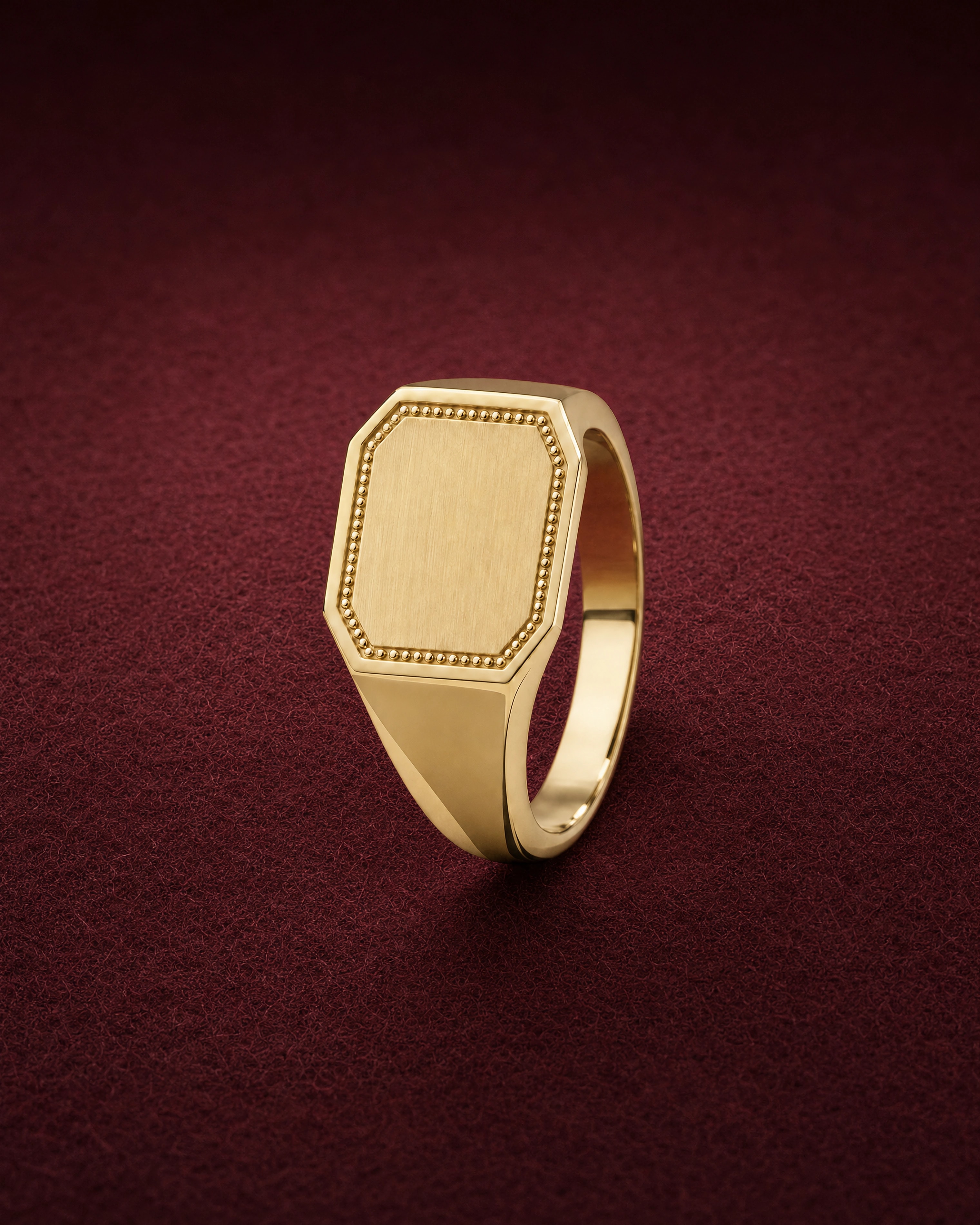
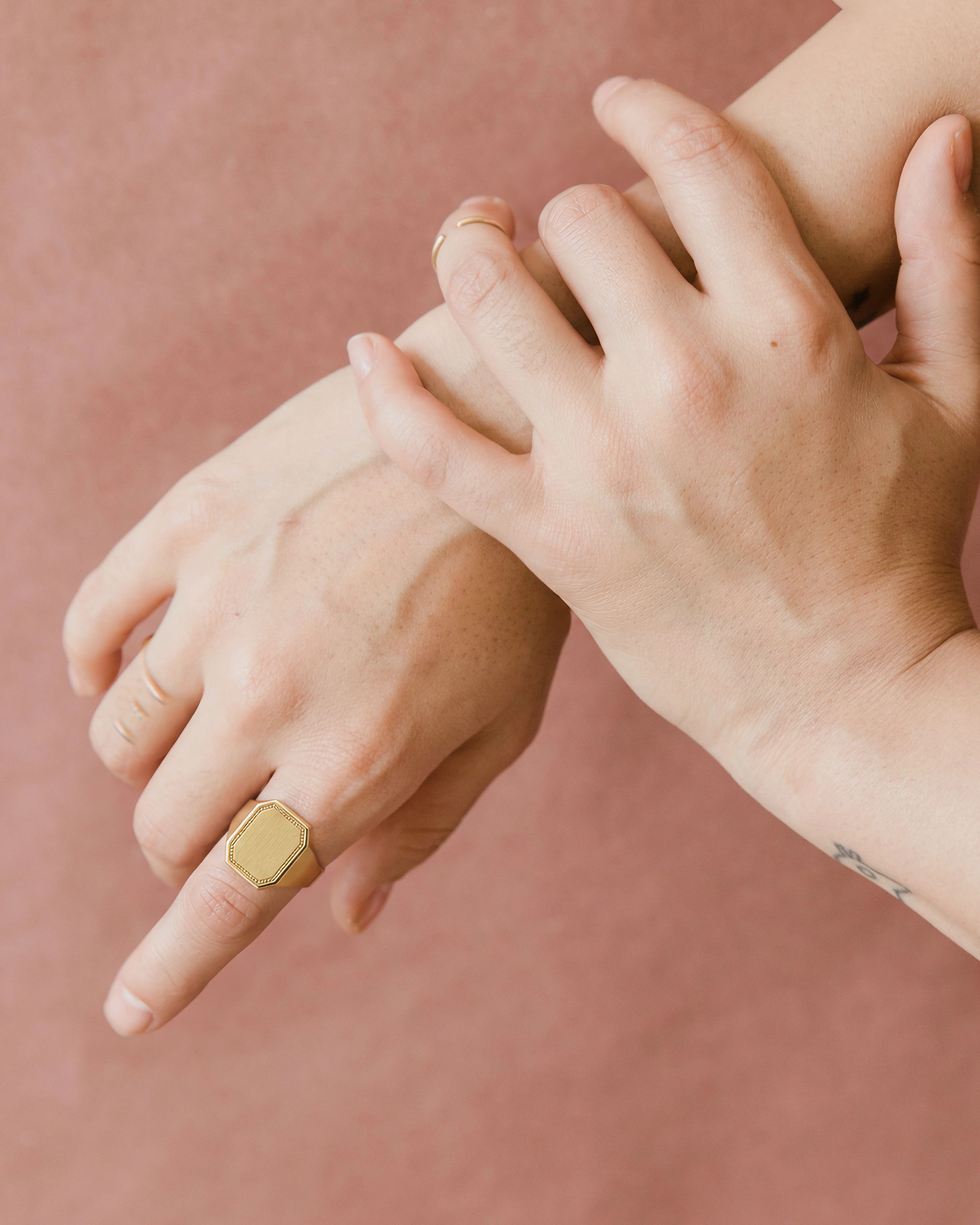
A wide band covers more skin, so it feels tighter than a thin band of the same size. As a rule of thumb, go up a half size for bands wider than 4 mm, and consider a full size up for very wide bands or signet rings with a heavy face. A thin stacking band of 1.5 to 2 mm usually fits true to size.
The inside profile matters too. A comfort-fit band, rounded on the inside, slides over the knuckle more easily than a flat inner surface and can feel slightly looser. Stacking several rings on one finger makes the group behave like one wide band, so if you plan to wear a stack, size the rings together.
Sizing a ring you plan to give
Buying a ring as a surprise means working from indirect information. The simplest route is to borrow a ring the person already wears on the same finger for an hour, measure it, and return it. If that is not possible, trace the inside of the ring on paper or press it into a bar of soap to keep an impression you can measure later.
When you are unsure, size up rather than down. A ring that is slightly large can be worn on another finger or sized down, while a ring that is too small cannot be worn at all until it is changed.
If the size turns out to be wrong
Most plain bands and solitaires can be resized by a goldsmith by a size or so in either direction. Full eternity rings, where stones run all the way around, and some stacked or patterned settings cannot be resized without rebuilding the ring, so it is worth taking extra care with those measurements before you order.
At VÉRA, eligible rings, meaning plain bands and solitaires, include one free resize within 60 days of delivery. After that, our New York studio resizes and repairs pieces at cost. Rings made or resized to a specific size at the time of order are final sale unless faulty, so if you are unsure, contact us at care@verafinejewelry.store before you order and we will help you work through the measurements.